Erase Sand - Lucky Balls
- 4.4
- Rating
- 1.00M
- Installs
- Free
- Price

 Analysis by App-foxy
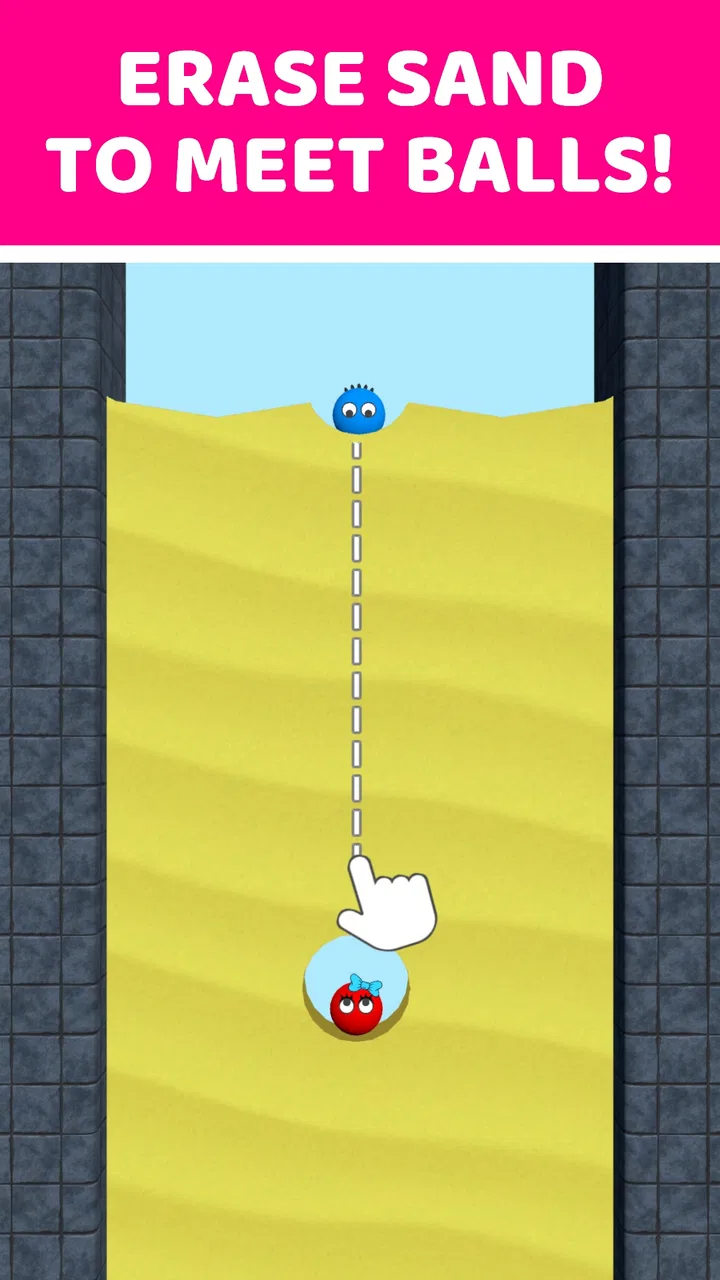
I did not expect a puzzle built around erasing sand to hold my attention for long, but Erase Sand - Lucky Balls has a simple idea that becomes surprisingly thoughtful once the levels stop being obvious. Instead of moving a character through a map or matching colored pieces, I clear paths through sand and try to guide balls toward their destination. The pleasure comes from watching the physics respond to a small decision: remove too much, leave a barrier in the wrong place, or open a route too early, and the whole attempt can fall apart.
That central action is the reason I would recommend this game to someone who likes short, tactile puzzle sessions. It is free, aimed at players aged Everyone 10+, and comes from HYPERCELL. The game sits firmly in the puzzle category, but it feels different from a conventional tile-matching title because the solution is shaped by space, timing, and gravity rather than by a fixed sequence of taps.
Why erasing the sand is the real puzzle
The important capability here is not simply removing sand. It is controlling a route without directly controlling the balls. I decide where the sand disappears, then let the balls react to the space I have created. That separation between planning and movement gives the game its character. I am not steering every object second by second; I am preparing an environment and accepting the consequences.
You May Also Like

 Blood Strike: 2.5 Anniversary
Blood Strike’s Loadouts Turn Every Drop Into a Tactical Gamble
A close look at Blood Strike’s custom loadouts: how fast access to signature weapons reshapes its battle royale rhythm, rewards preparation, and narrows the gap between fights.

 Pandora - Music & Podcasts
Pandora’s Music Is Easy to Start, but Harder to Recover
Pandora’s strength is its low-effort path from a seed to a station. Its weak spot is how much confidence it asks you to place in connection, setup, and quiet recovery.

 8 Ball Pool
 Is Built on Rivalries, Rematches, and Routine
A close look at the rivalries, rematches, shared routines, and unanswered safety questions that turn a quick pool match into a persistent mobile community.

 Samsung Music
’s Quiet Strength Is Playing What You Already Own
Its reach comes less from spectacle than from dependable access to a personal library. That simplicity is both the app’s strongest retention engine and its ceiling.

 AccuWeather: Weather Radar
AccuWeather Review: A Quick, Clear Forecast for Everyday Decisions
For everyday plans, the best forecast is the one you can understand quickly. AccuWeather makes rain timing, radar, and local conditions easy to act on, with a few trade-offs.

 Hill Climb Racing
Why Hill Climb Racing Still Turns Crashes Into One More Run
A tiny car, a bumpy hill and one more upgrade: Hill Climb Racing keeps resurfacing because its simple chaos makes every near-miss feel personal.
More From Our News Desk



That makes each level feel like a small experiment. I look at the position of the balls, the available space, and the likely direction they will take once the sand is cleared. A narrow opening may be safer than a large one, while a complete removal can send everything rolling before I am ready. The best solutions are often less about speed and more about restraint.
I found this especially satisfying because the interaction is easy to understand without being completely mindless. A first attempt can usually be made within moments, but a successful solution may require thinking about the order in which areas are erased. The game turns a very ordinary gesture—dragging or clearing a patch of sand—into a decision about momentum, separation, and risk.
The visual idea also makes the result easy to read. When the sand gives way and the balls begin moving, I can immediately see whether my plan is working. There is no need to interpret a complicated interface or memorize a large set of rules. The challenge comes from the arrangement of the puzzle itself, not from learning a difficult control scheme.
Small changes can completely alter the outcome
One of the less obvious lessons is that the shortest-looking route is not always the safest one. If I create a direct channel, a ball may travel too quickly or enter an area before another ball is in position. Leaving a little sand in place can act like a temporary wall, allowing me to control how the space opens. That is the kind of detail that gives the game more depth than its short description suggests.
I also learned to treat the sand as a set of possible brakes rather than merely an obstacle. A remaining mound can slow movement, divide the play area, or prevent a premature collision. This changes how I scan a level: instead of asking only “What should I erase?”, I ask “What should remain until the last moment?” That shift is useful when a puzzle appears to have several equally plausible routes.
Another practical tip is to watch the first movement before committing to a broad clearing action. A small opening can reveal how the balls respond, and that information is often more valuable than guessing the entire solution immediately. I prefer this cautious approach on harder layouts because restarting after a careless opening is less satisfying than building the route in stages.
How a typical session feels in practice
I can pick up the game for a few minutes without needing a long warm-up. The basic interaction is direct, and the puzzle format suits moments when I want something active but not demanding in the way a competitive game can be. It works well while waiting for an appointment, during a short break, or at the end of the day when I want a clear goal without a complicated story to follow.
A normal attempt begins with observation. I check where the balls are positioned and identify the likely destination or safe area. Then I remove enough sand to create movement while trying not to destroy the structure that keeps the puzzle manageable. Once the balls start rolling, I watch for unexpected changes and decide whether my initial plan was sensible or too aggressive.
The physics-based response is the main source of feedback. A successful route feels earned because I caused it indirectly. I did not simply select the correct answer from a menu; I shaped the conditions that allowed the answer to happen. When a plan fails, the reason is usually visible enough to teach me something. Perhaps I opened a passage too wide, removed support too soon, or ignored the way one ball could affect another.
That learning loop is more important than it may first appear. The game does not need a complex rulebook to create progression in the player’s thinking. I gradually become more careful about where I erase, how much I remove, and when I allow movement to begin. The controls stay approachable while my decisions become more deliberate.
A useful way to approach difficult layouts
When I reach a puzzle that looks crowded, I divide it mentally into stages. First, I identify which ball needs to move earliest. Next, I look for sand that can be removed without disturbing the other routes. Finally, I preserve any section that could function as a divider or stop. This method is more reliable than clearing the largest visible area because it keeps the puzzle’s structure intact.
I also try not to judge a failed attempt too quickly. A mistake can show that a route is possible but needs a different opening point. If the balls move in the right general direction before the attempt breaks down, I usually keep the broad idea and change only the timing of the erasure. That makes retries feel like problem solving rather than random trial and error.
For a child or younger player within the age guidance, this could be a gentle introduction to cause and effect, provided an adult is comfortable with the game’s overall presentation. For an adult, the appeal is less educational and more about the calm satisfaction of arranging a physical process. I would not call it a pure relaxation app, since some layouts can be frustrating, but it is far less intense than action-oriented alternatives.
The everyday situation where it works best
My favorite use case is a short waiting period when I want a game that can be understood immediately and put down without losing a long chain of progress. I can open a level, study it, make a few attempts, and stop when the appointment or journey continues. That makes the sand-clearing format more practical than a story-heavy puzzle game that expects a longer uninterrupted session.
It is also a good choice for someone who enjoys watching a solution unfold. Players who like sorting, matching, or word puzzles may appreciate the same sense of completion, but the route here is visual and physical. I get immediate feedback from the movement of the balls, so the result feels more animated than filling in a grid or selecting a correct word.
At the same time, I would not choose it for a player who wants deep narrative, character development, or a large strategic system. The attraction is concentrated in the sand-and-ball interaction. If that mechanic does not appeal to you, there is not much reason to force yourself through it just because it is free. A traditional logic-puzzle collection may be a better fit for someone who prefers abstract deduction, while a physics sandbox may suit someone who wants more freedom to experiment without a defined solution.
The game is particularly approachable for people who are new to mobile puzzles. The core idea can be understood through observation, and the action does not require complicated combinations. I would still expect some patience from anyone who dislikes repeating a level after a small mistake. Physics puzzles can feel unfair when the result is not exactly what I expected, even when the failure is technically caused by my own poor planning.
Where the simplicity helps and where it becomes limiting
The strongest trade-off is that the same focused mechanic that makes the game accessible can also make it feel narrow. I enjoy the clarity of clearing sand and guiding balls, but I do not get the variety of a puzzle game built around several unrelated systems. The experience depends on the layouts continuing to present fresh problems through the same basic interaction.
That means the game is best enjoyed in measured sessions. I would not necessarily sit down expecting a long marathon, because repeating the same type of gesture for too long can reduce the sense of discovery. Short play keeps the physics feeling satisfying and gives me time to think about each level instead of rushing through it mechanically.
Another point to keep in mind is that indirect control can be both the charm and the source of irritation. When I guide a ball only by changing its surroundings, I feel clever when the route works. When a ball moves differently from what I imagined, I may wish I had more direct control. Players who prefer precise button inputs should know that this is intentionally not that kind of game.
The game’s free price makes it easy to try, and its broad age guidance lowers the barrier for casual households. Still, “free” does not automatically mean it will suit every playing habit. Someone looking for a substantial long-term hobby should compare it with larger puzzle games before committing time. I see this one as a focused diversion first, not as a replacement for every other type of puzzle experience.
It is also worth approaching the physics with a flexible mindset. I do not expect every attempt to behave like a perfectly predictable mathematical diagram. The enjoyment comes partly from observing the result and adjusting. If you want a rigid puzzle where one exact input always produces an identical, sharply defined response, a grid-based logic game may feel more dependable.
How it compares with familiar puzzle alternatives
Compared with match-three games, this title asks for more spatial planning and less pattern scanning. I am not building combinations under pressure; I am designing a route through a changing physical space. Compared with word puzzles, it is more visual and less language-dependent. Compared with classic maze games, I am not moving a character through corridors directly. I am altering the corridors and letting the balls do the traveling.
That difference matters when choosing what to play. If I want a quick mental reset with visible movement, the sand mechanic has an advantage. If I want a broad selection of challenge types, a puzzle collection will probably offer more variety. If I want competitive scores or fast reflexes, this is not the obvious choice. Its identity comes from controlled experimentation rather than speed or social comparison.
The developer, HYPERCELL, has positioned the game around a very readable premise, and the current version is 1.13.0. It runs on Android devices using version 7.0 or later, which makes it accessible to many older phones as well as newer hardware. I would still judge the experience on the particular device in hand, especially if the screen is small, because careful sand removal benefits from enough room to see the route clearly.
Who will get the most from it
I think the best audience is anyone who enjoys short physics puzzles with indirect control. You will probably like it if you enjoy testing a plan, seeing a physical result, and refining the same idea until the balls reach safety. It is also suitable for casual players who want an immediately understandable game rather than a large world to learn.
It can work well as a family-friendly option for players covered by the Everyone 10+ guidance, although I would still let each household decide whether the presentation is appropriate for its children. The controls are simple enough for a newcomer, while the later thinking can reward someone who pays attention to timing and structure.
The game has already attracted more than a million installs and holds a 4.4 average from roughly eighteen thousand ratings. Those figures suggest that the concept connects with a substantial casual audience, but they should not replace personal judgment. A popular physics puzzle can still be the wrong fit for someone who dislikes retries, indirect movement, or a tightly focused mechanic.
I would skip it if my priority were a story campaign, elaborate character progression, multiplayer competition, or a large collection of radically different puzzle rules. I would also look elsewhere if I wanted complete control over every moving object. Here, my role is closer to an architect than a driver: I prepare the route, then watch the system respond.
For me, that role is exactly what makes the game memorable. The most satisfying moments do not come from erasing the most sand. They come from removing just enough, leaving the right barrier in place, and allowing the balls to follow a path I created without directly commanding them. That small distinction gives the game its personality.
My recommendation after spending time with it
Erase Sand - Lucky Balls is a focused puzzle game that earns its place through one clear idea: erase the environment, not the objective. I appreciate that it can be opened quickly, understood without a tutorial-heavy introduction, and enjoyed through a handful of thoughtful attempts. The physics make success feel active, even though the controls remain simple.
Its limitations are equally clear. The experience does not promise broad genre variety, and indirect movement may frustrate players who want exact control. I also think the strongest way to enjoy it is in short sessions, because the central interaction is more appealing when I give each layout attention instead of treating it as an endless sequence of taps.
Still, I would recommend giving it a try if you like visual cause-and-effect puzzles and want something different from matching tiles or solving words. The free entry point makes that decision easy, and the game’s central mechanic has enough nuance to reward more than a quick glance. My advice is to play slowly at first, preserve sand that might help control movement, and think of every failed attempt as information about the route.
In the end, this is not a game I would choose for every mood, but it is a game I return to when I want a compact challenge with a satisfying physical payoff. Its best moments come from patience: clear a little, observe the movement, and let the puzzle reveal why the smallest change can make the whole solution work.
FAQs for Erase Sand - Lucky Balls
01What is the main objective of Erase Sand - Lucky Balls?
In Erase Sand - Lucky Balls, the main objective is to strategically erase sand to guide the lucky balls into designated targets. Players must solve puzzles by carefully removing sand in a way that allows the balls to roll naturally towards their goals, utilizing gravity and physics-based challenges.
02Is Erase Sand - Lucky Balls free to download and play?
Yes, Erase Sand - Lucky Balls is free to download and play. However, it may include in-app purchases that offer additional features, such as special tools or hints, to enhance the gameplay experience. These purchases are optional and not required to progress in the game.
03What platforms is Erase Sand - Lucky Balls available on?
Erase Sand - Lucky Balls is available for both Android and iOS devices. You can find it on the Google Play Store and the Apple App Store. Ensure that your device meets the necessary system requirements for the best gaming experience.
04Are there any ads in Erase Sand - Lucky Balls?
Yes, Erase Sand - Lucky Balls includes ads, which help keep the game free for all users. These ads may appear between levels or as banners. You can usually remove ads by making a one-time in-app purchase, allowing for an uninterrupted gaming experience.
05Does Erase Sand - Lucky Balls require an internet connection?
Erase Sand - Lucky Balls can be played offline, making it a perfect game for on-the-go entertainment when internet access is limited. However, certain features, such as in-app purchases or updates, require an internet connection to function properly.
Pros
- Intuitive gameplay mechanics.
- Visually appealing graphics.
- Challenging levels increase fun.
- Smooth and responsive controls.
- Regular updates with new features.
Cons
- In-app purchases can be pricey.
- Occasional ads disrupt play.
- Limited free levels available.
- Requires internet for certain features.
- Can drain battery quickly.

Erase Sand - Lucky Balls
Gallery